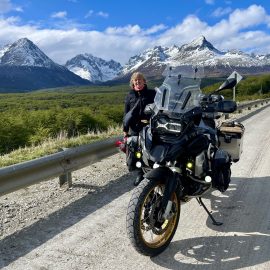
We had a good few days sitting about Buffalo doing nothing much apart from walking to the local ‘historical’ bar. They call any bar ‘historical’ in these parts if it’s over 100 years old.
At least this pub had bullet holes in the walls and I had a drinking partner looking over me.
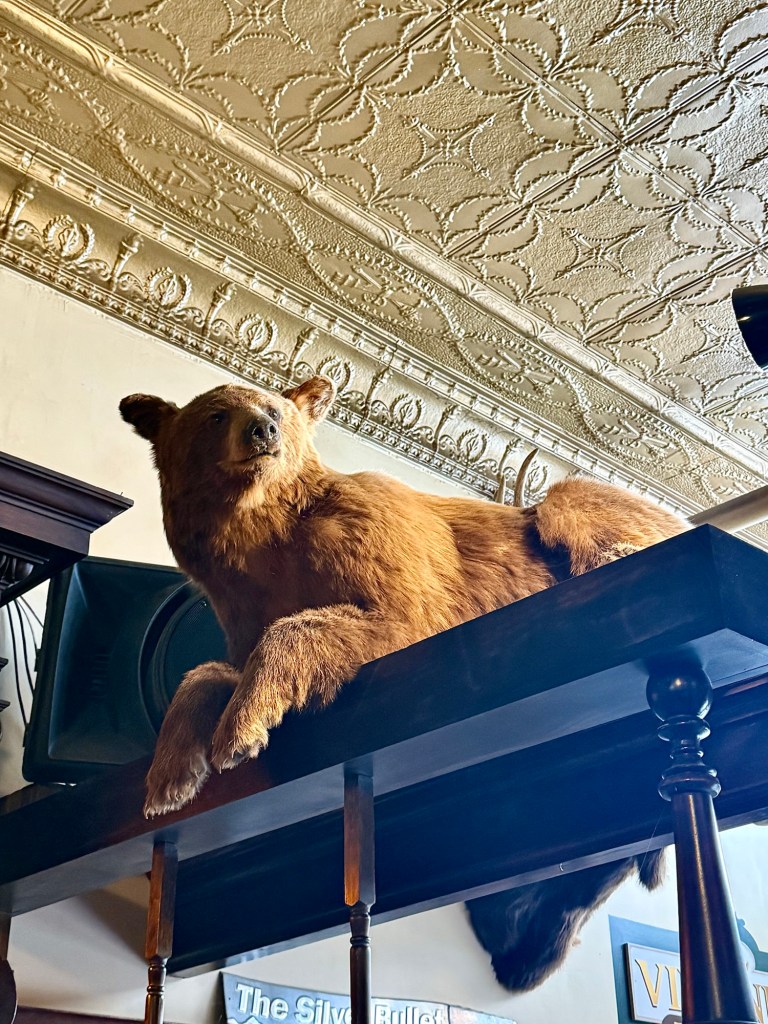
There was a multitude of stuffed animals in this bar including a huge moose heid and a standing grizzly bear. I like stuffed animals on walls. Susan doesn’t.
We left Buffalo and my stuffed animal friends and headed north to visit the site of the ‘Battle of the Greasy Grass’.
Where’s that? you most certainly will be asking? Well let me enlighten you once again.
It’s the site of the Battle of the Little Bighorn. You know the one – Custer’s Last Stand. Where the 7th Cavalry were defeated by the Lakota, Cheyenne and Arapaho tribes in 1876.
The Battle of the Greasy Grass is what the plains Indians called it and, as they always say, the victors get to write history, then I think it’s only appropriate we give it its correct name.
We stopped for lunch at the trading post run by native Americans and we each had an ‘Indian Taco’.

That’s deep fried bread with chilli and stuff. Delicious. Bit more calorific than a Scottish deep fried pizza and I’m not sure how Susan mentally coped with it. That said she certainly stepped up – there’s a real man in there somewhere!
So what happened at Greasy Grass?
Well the Native Americans were being persecuted, their ‘agreed’ lands appropriated and treaties ignored. Bad duplicitous white man.
The US Government, under President Ulyssses S. Grant, then ordered the Sioux to leave the South Dakota Badlands (their home) by the end of January knowing they wouldn’t be able to make the trek during the harsh winter. The government planned to use this as an excuse to expand hostilities. Really bad white man.
When the subsequent US campaign against the Native Americans began in mid-May, a large group of Lakota Sioux, Cheyenne and Arapaho tribes had already converged for a meeting called by Sitting Bull. An estimated 2,000 warriors and their families gathered on the banks of the Little Bighorn River. It was a huge encampment.
The Native Americans were no doubt wondering what to do next when along comes Custer and his 650 men of the 7th Cavalry.
George Armstrong Custer gained fame during the civil war (he was on the right side) and in post war conflicts with Native Americans. He was capable, experienced, vainglorious and eager for more battle glory.
Custer didn’t scout the camp properly, didn’t listen to advice, and was unaware of the true numbers of Native American warriors encamped there.
He split his forces into three battalions in an attempt to prevent any American Indians from escaping from either side. He wanted this to be a complete victory.
This was a huge tactical error when faced with an overwhelmingly superior strength enemy as his battalions were unable to support each other.
Of course, his batallion took the centre position, the position where he could get most glory.
The 7th cavalry engaged the Native American encampment thinking it would be an easy victory. They were eager for battle and thought it would be a rout.
The first action was the battalion, under the Command of Major Reno, flanking the village and opening fire on warriors, women and children. The soldiers were charged, defeated and retreated.
The other battalion, commanded by Capt. Benteen, was still approaching Little Bighorn and too far away to assist. Everything had started too early in a effort to stop any Native Americans from potentially escaping.
Once Reno retreated to a defensive position, the Native Americans turned their attention to Custer and his 210 men.
Custer’s Last Stand lasted under an hour as they tried to defend the high ground above the village. They were all killed and the only accounts of this ‘stand’ were from Native Americans. They said the soldiers fought courageously to the end.
The stones mark where some of them fell. It’s not widely known that Custer’s brother fought and died by his side.


Only a single, badly wounded horse survived from Custer’s batallion. Oh, I know some of you will be more concerned about the horse so I can tell you it subsequently lived a long life and was a bit of a celebrity horse.
Personally, I would like to have seen the horse’s head stuffed and on the wall in a ”historical’ bar I could visit. Wouldn’t that be great? Susan would disapprove.
The outcome of the battle, though it proved to be the height of Indian power, so stunned and enraged white Americans that government troops flooded the area, forcing the Indians to surrender.
Here’s a photo of the memorial stone at the 7th Army mass grave. Over 200 soldiers and scouts from at the ‘Last Stand’ lie here. Custer was reinterred at West Point Cemetery.

Let’s not forget Native Americans who died that day protecting their families, their freedom and their way of life.


Indian battle memorial outlook looking up to the mass grave of the 7th Cavalry.

Historians debate the pre-European population of North America and whilst disease and famine played a significant role, the American Indian Wars fought by European colonial empires against various Indian tribes has been characterised as genocide.
By the close of the Indian Wars in the late 19th century, fewer than 238,000 indigenous people remained. A sharp decline from the estimated 5 million to 10 million living in North America when Columbus arrived in 1492.
This was done in the name of civilization?
‘When we show our respect for other living things, they respond with respect for us’.
Arapaho Proverb.
 Biking The Americas Act IV
Enjoyed the tale of the Greasy Grass/ Little Bighorn and the pics. The Taco looks like the day’s healthy option! Willie
LikeLiked by 1 person
Thanks Clif. Interesting and informative as always!
Your weather look a lot better the further North you go !
LikeLike
strangely I was reading about the battle – if you can call it that- some weeks ago
D
LikeLike